Sunday, 24 February 2019

An emotional 75th anniversary flypast marking the loss of WW2 bomber Mi Amigo.


On the 22nd Feb 2019 10,000+ people gathered in Endcliffe Park in Sheffield to pay tribute to the 10 American airmen who lost their lives when their aircraft crashed into the park on this day in 1944. 

The B-17 Flying Fortress – known as Mi Amigo – plunged into woodland in the park and there were no survivors. Mi Amigo crashed 75 years ago today.

The World War Two aircraft was of the 364th Bomber Squadron and was based at Chelverston on Northamptonshire. On that fateful day in 1944 the plane and its crew were on a mission over Denmark when it was badly damaged by a German fighter plane. The stricken plane, piloted by the heroic Lt John Kriegshauser, made its way back to UK with the hope of finding somewhere safe to land. 

It is believed the crew identified the large field in Endcliffe Park as a possible landing spot. Eyewitnesses say the plane circled the park for a time and it is believed the pilot sacrificed the lives of himself and his crew to avoid a group of children in the field. 

Lt Krieghauser's heroic actions that day earned him a posthumous US Distinguished Flying Cross for his courage. 

A number of trees were uprooted in the crash and in 1969 a grove of American oaks was planted in 1969 as replacement trees to honour the crew. 

There is also a memorial to the crew in the park and Sheffield man Tony Foulds,  who was one of the boys in the park at the time of the crash, has personally tended to the memorial for decades. 

Today's memorial flypast is a direct result of a campaign led by 82-year-old Tony.


Sunday, 14 October 2018

Mount Kinabalu - Borneo

Mount Kinabalu’s specialty lies in its location at a renowned World Heritage Site, Kinabalu Park. Nature lovers will be delighted to be able to witness the many variations of flora and fauna that are to be found on the mountain at different altitudes.

Mount Kinabalu, along with other upland areas of the Crocker Range is well-known worldwide for its tremendous botanical and biological species biodiversity with plants of Himalayan, Australasian, and Indo-Malayan origin.

A recent botanical survey of the mountain estimated a staggering 5,000 to 6,000 plant species (excluding mosses and liverworts but including ferns), which is more than all of Europe and North America (excluding tropical regions of Mexico) combined. It is therefore one of the world’s most important biological sites.

Standing majestically at 4,095m (13,435 feet above sea level), Mount Kinabalu is the highest mountain between the Himalayas and New Guinea. Mount Kinabalu derives its name from the Kadazan word, ‘Aki Nabalu’, meaning ‘the revered place of the dead’. It is one of the safest and most conquerable peaks in the world—provided that you’re reasonably healthy and physically fit.

It took two days to climb up and down Mount Kinabalu. The Summit trail starts from the Timpohon Gate (1,800m) which is located near the Kinabalu Park Headquarters. Before reaching Panalaban (3,273m), we encountered a series of trail shelters (pondok) — Pondok Kandis (1,981m), Pondok Ubah (2,095m), Pondok Lowii (2,286m), Layang-Layang (2,702m), Pondok Villosa (2,690m), and Pondok Paka (3,080m). The climb from Timpohon Gate to Panalaban takes approximately 6 to 8 hours.

Upon arriving at Panalaban, we had some time to rest and recharge own energy. The climb to the summit resumed 2.45am the next morning. The climb to reach the summit requires climbers to climb endless steps and a scramble pulling yourself up a rope. The climb from Panalaban to the summit normally takes 4 to 5 hours before sunrise.


Kundasang War Memorial - Borneo

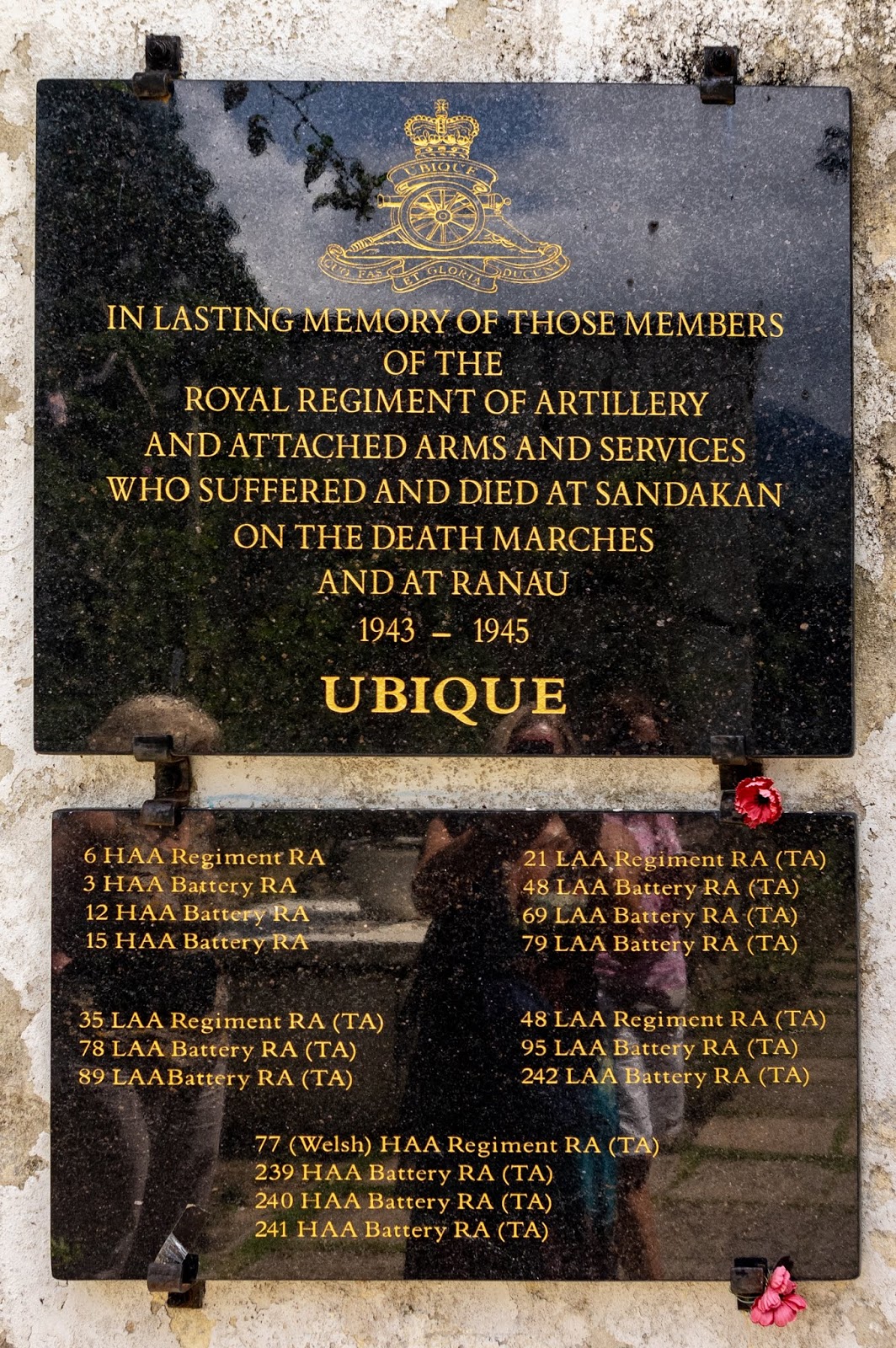
A must visit in Kundasang is the Kundasang War Memorial. Established in 1962, this was one of the first memorials to commemorate the brave Australian and British Prisoners of War who died in Sandakan and during the infamous death marches to Ranau during World War II. The memorial also remembers the people of North Borneo who risked their lives to help the POWs.

The Memorial is made up of four beautiful gardens - the Australian Garden, the English Garden, the Borneo Garden and the Contemplation Garden and Pool - to represent the different nationalities. With its towering pine trees and blooming roses, a walk in the gardens is reminiscent to that of a stroll in a quaint English garden. The scent of roses lingers in the air and the serene atmosphere makes the Kundasang War Memorial an ideal place to contemplate and remember the heroes of the war. Visitors can also opt to view a brief video on the history of the Sandakan Death March.